
Recommended program
Strong directional fit
Data Analytics + Gen AI
Readiness note
Answer nine focused questions about your background, preferred work, technical comfort and learning capacity. You will receive a recommended program, the reasons behind it and the closest alternative to compare.
Your result is program-selection guidance. It is not an admission decision, aptitude score or prediction of employment or salary.
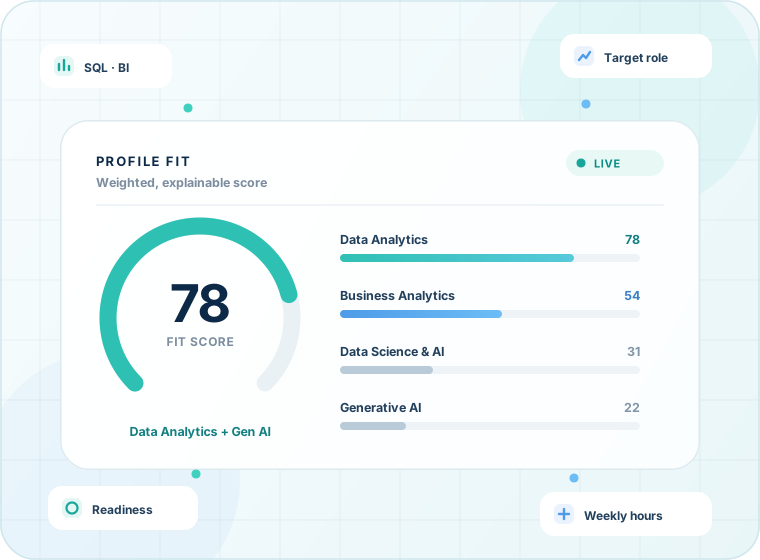
Your result combines preferred work, role direction, current experience, technical comfort and learning capacity. Career direction carries more weight than your degree title.
Wanting to build dashboards, business recommendations, ML systems or LLM applications changes the pathway more than a degree title does.
Coding and mathematics confidence help identify the learning curve. They are not used as automatic rejection rules.
Adjacent programs can be sensible when your target work overlaps. Compare the top two before making an enrolment decision.
Share your details and we will include the recommended pathway with your enquiry. An admissions advisor will respond within 12 working hours. Review the Privacy Policy before continuing.
The assessment gives the greatest importance to the work and role you want to pursue, then considers your current technical comfort, experience and available learning time.
What you want to do is the strongest signal because each program is designed around a different type of work.
These signals help estimate whether an analytics-first, model-heavy or application-building path is the more natural next step.
Current exposure adjusts the starting point but does not assume that a past degree permanently defines your future role.
Your available time helps identify planning considerations for more technically demanding pathways without changing the published curriculum.
Your result highlights a recommended program and the closest alternative. Review both curricula before deciding, especially when your interests cross more than one field.
Best aligned with structured-data analysis, SQL, reporting, dashboards and insight communication.
18-week curriculum · 6 modulesExplore → BABest aligned with KPIs, business questions, scenarios, stakeholder recommendations and decision support.
18-week curriculum · 5 modulesExplore → DSBest aligned with mathematics, machine learning, deep learning, experiments and model deployment.
36-week curriculum · 8 modulesExplore → GABest aligned with LLM applications, prompting, RAG, tool use, agents and AI product workflows.
16-week curriculum · 5 modulesExplore →Review the recommended curriculum, compare the closest alternative and discuss any remaining trade-offs before enrolling.
Program comparisonSee how your interests and readiness align with the four program directions.
Clear reasoningUnderstand which answers influenced your top matches.
Directional guidanceThe result is not an admission decision or measure of ability.
Responsible expectationsIt does not predict employment, salary, placement or career-transition speed.
Share your background, target role and any trade-offs you are considering. Skillsbiz Education admissions will respond within 12 working hours.