
01
Data Analytics + Gen AI
Moderate
Foundational
High
Very high
Light
Applied layer
Compare the work each pathway develops: analysing and communicating data, supporting business decisions, building predictive systems or engineering LLM-powered applications.
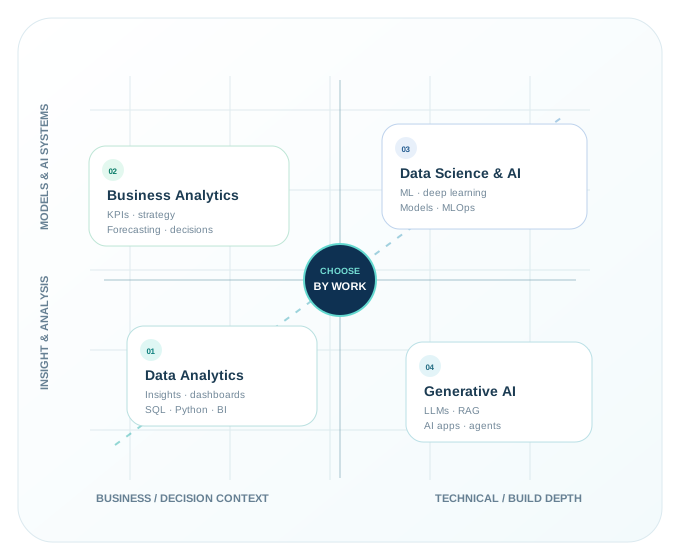
Best suited to querying data, finding patterns, building dashboards and communicating insights clearly.
Best suited to KPI design, commercial analysis, decision support and evidence-backed recommendations.
Best suited to deeper coding, mathematical reasoning, machine learning and model deployment.
Best suited to LLM applications, retrieval systems, multimodal tools and agentic workflows.
Each program includes eight portfolio projects, live online weekday or weekend batches and up to 12 zero-interest EMIs. The profile match and depth labels are directional guidance, not admissions decisions or eligibility scores.
Select the description closest to your current background, then the kind of work you want to move toward. The result is a directional recommendation designed to help you compare intelligently.
Programs may share tools while developing different capabilities. These qualitative profiles show where each pathway places greater learning emphasis.
These are qualitative comparison profiles—not test scores, prerequisites, admissions cut-offs or measured percentages.
Review duration, curriculum, fee, technical intensity, project direction and role alignment before choosing your program.
| Dimension | 01Data Analytics + Gen AI | 02Business Analytics + Gen AI | 03Data Science & AI | 04Generative AI |
|---|---|---|---|---|
| Program duration | 6 months | 6 months | 12 months | 4 months |
| Structured curriculum | 18 weeks | 18 weeks | 36 weeks | 16 weeks |
| Modules | 6 | 5 | 8 | 5 |
| Portfolio projects | 8 | 8 | 8 | 8 |
| Program fee | ₹1,10,000 + GST | ₹1,10,000 + GST | ₹1,40,000 + GST | ₹90,000 + GST |
| Delivery | Live online · weekday or weekend batches | Live online · weekday or weekend batches | Live online · weekday or weekend batches | Live online · weekday or weekend batches |
| Payment option | Up to 12 zero-interest EMIs | Up to 12 zero-interest EMIs | Up to 12 zero-interest EMIs | Up to 12 zero-interest EMIs |
| Primary work | Analysis, dashboards, reporting and insight communication | Business diagnosis, KPI design, forecasting and recommendations | Predictive modelling, experimentation, deep learning and ML systems | LLM applications, retrieval, tool use and AI workflows |
| Best starting background | Graduates, career switchers, operations/MIS learners, early analysts | Business, operations, finance, marketing, consulting or MBA-oriented learners | Technical/quantitative learners, analysts moving into modelling, developers | Developers, technical analysts, product builders and AI application learners |
| Coding guidance | Moderate; Python becomes an analysis tool | Light–moderate; programming supports business analysis | Very high; Python is a core working environment | High; application logic and API integration matter |
| Math guidance | Statistics for analysis and interpretation | Statistics for decisions, forecasting and business reasoning | Strong mathematics for ML and deep learning | More architecture/application reasoning than heavy mathematical derivation |
| Portfolio centre | Dashboards, analytical investigations and reporting workflows | Decision packs, KPI systems, business cases and recommendation narratives | Predictive models, experiments, deep-learning systems and deployment | RAG apps, AI assistants, tool-using workflows and GenAI prototypes |
| Role direction | Data Analyst, Business Intelligence Analyst, Reporting Analyst and junior data-focused roles | Business Analyst, Strategy Analyst, Operations Analyst and Marketing Analyst | Data Scientist, Machine Learning Engineer, AI Developer and research-oriented data/AI roles | Generative AI Engineer, LLM Developer, AI Product Engineer and other applied LLM-building roles |
| Choose this if... | You want to become strong at turning raw data into decisions people can understand. | You want analytics to sit close to business strategy, operations or commercial decisions. | You genuinely want deeper coding, modelling and technical AI problem-solving. | You want to build applications around LLMs rather than study the full classical ML stack first. |
| Consider another program if... | Your real goal is deep ML engineering or advanced model research. | You want a highly technical ML path with substantial mathematical depth. | You mainly want dashboards, business reporting or a shorter analytics transition. | You want broad classical ML, computer vision and deep-learning foundations. |
The module sequence shows how each program develops capability from foundations through applied work and career preparation.
6 months · 18 weeks · 6 modules
6 months · 18 weeks · 5 modules
12 months · 36 weeks · 8 modules
4 months · 16 weeks · 5 modules
These are the comparisons that matter more than whether both courses happen to mention Python, SQL or AI.
Prioritise querying, analysis, dashboards, reporting and explaining patterns.
Prioritise KPI framing, commercial context, diagnosis and recommendations.
Faster route toward analysis and BI-oriented work with moderate coding depth.
Longer technical route into modelling, deeper mathematics and ML systems.
Broader classical ML, deep learning, CV/NLP and deployment foundations.
Focused on LLMs, prompting, retrieval, tool use and GenAI applications.
Use analytics and AI as decision-support tools inside business functions.
Build AI-enabled products, assistants and application workflows.
Compare the work you want to do, the depth you are ready for and the support you need—not just the tools listed in the curriculum.
Browse all program pagesNo. A longer technical program only makes sense if the target role requires that depth. Someone targeting BI or business analysis may get more value from a focused analytics pathway than from studying deep learning simply because it sounds more advanced.
Data Analytics + Gen AI and Business Analytics + Gen AI are usually the first two worth comparing. Choose between them based on whether you want to spend more time working directly with data and reporting, or closer to business framing, KPIs and recommendations.
Yes. Analytics experience can create useful foundations in data handling, SQL and business problem framing. Moving into Data Science still requires a meaningful step up in Python, mathematics, modelling and experimentation.
No. Generative AI is a focused application domain built around modern language-model systems. Data Science & AI covers a broader machine-learning foundation, including advanced ML, deep learning, computer vision, NLP and MLOps.
Yes. Data Analytics + Gen AI and Business Analytics + Gen AI are ₹1,10,000 + GST each; Data Science & AI is ₹1,40,000 + GST; and Generative AI is ₹90,000 + GST. All four programs offer up to 12 zero-interest EMIs.
Every program is delivered live online in a cohort of no more than 20 learners, with weekly one-to-one mentoring and written feedback. Learners also receive class recordings for 12 months after completion, lifetime access to learning materials, the option to repeat a batch for up to five years and five years of doubt support.
Yes. After meeting the program requirements, learners receive a Certificate of Completion in their specific program, issued and digitally verifiable by Skillsbiz Education.
Book a free counselling session to compare prerequisites, duration, fees and role alignment before you apply.