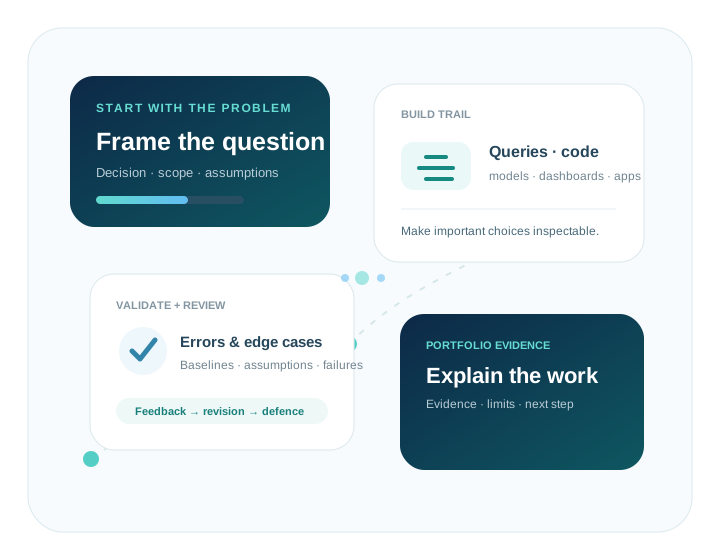
Build a portfolio that shows how you solve problems.
Every program includes eight applied projects, mentor review and capstone work. You practise with realistic Indian business contexts and public or synthetic datasets, then refine selected work into clear, professional portfolio evidence.
8 projects per programMentor-reviewed workWritten feedbackCapstone development
Start with
A realistic brief
Understand the question, intended user, constraints and evidence required.
Develop through
Independent decisions
Choose methods, tools, assumptions and checks instead of copying a finished example.
Improve with
Mentor feedback
Review technical choices, validation, interpretation and communication.
Present as
Portfolio evidence
Refine the problem, approach, result and limitations into a clear project story.
Sample project directions
Explore the problems, outputs and tools used across each pathway.
Filter the gallery by program or output type. These representative briefs show the style and depth of applied work; your current curriculum and project sequence are confirmed in the program brochure.
Designed for genuine practice: project scenarios use realistic Indian contexts with public or synthetic datasets. They are educational assignments unless a separate client engagement is explicitly identified.
Program
Output
12 sample briefs
Data Analytics + Gen AIGuided → Intermediate
Retail Performance Diagnostic
Find the strongest and weakest performance patterns, then turn them into a dashboard and decision-ready analytical note.
Business problemPerformance diagnosis across products, regions and time
ExcelSQLPower BI
Data Analytics + Gen AIIntermediate
Customer Retention Cohort Analysis
Use cohort logic to reveal retention patterns without overstating why customers stay or leave.
Business problemRetention variation by cohort and segment
SQLPythonTableau
Data Analytics + Gen AIIntermediate
Operations SLA Exception Tracker
Transform operational events into a reviewable view of delays, exceptions and recurring bottlenecks.
Business problemService-level exceptions and process bottlenecks
ExcelSQLPower BI
Business Analytics + Gen AIIntermediate
Pricing Scenario Decision Pack
Compare pricing choices through assumptions, scenarios and trade-offs rather than a single unsupported answer.
Business problemPricing decision under demand and margin uncertainty
ExcelSQLPower BI
Business Analytics + Gen AIIntermediate
Marketing Allocation Review
Turn channel and funnel data into a structured recommendation while keeping attribution limitations visible.
Business problemMarketing efficiency and resource allocation
ExcelPower BIPython
Business Analytics + Gen AIIntermediate → Advanced
Inventory & Capacity Planning
Model operational constraints and trade-offs without pretending one forecast can remove uncertainty.
Business problemCapacity, service levels and inventory trade-offs
ExcelSQLTableau
Data Science & AIIntermediate → Advanced
Demand Forecasting Model Comparison
Build and compare forecasting approaches with honest validation and visible failure analysis.
Business problemPlanning under uncertain future demand
PythonPandasscikit-learn
Data Science & AIAdvanced
Customer Churn Risk Model
Develop a risk-ranking model and show where it succeeds, where it fails and how thresholds change decisions.
Business problemRetention prioritisation using predictive risk
PythonSQLscikit-learn
Data Science & AIAdvanced
Support Ticket Text Classifier
Use NLP to classify support requests while keeping uncertainty, routing errors and operational safeguards visible.
Business problemText classification for operational routing
PythonNLPscikit-learn
Generative AIIntermediate → Advanced
Knowledge-Base RAG Assistant
Build a document-grounded assistant where retrieval quality, citations and failure handling are part of the product.
Business problemGrounded question answering over approved knowledge
PythonLLM APIVector search
Generative AIAdvanced
Tool-Using Research Workflow
Design a controlled multi-step assistant that can call tools, preserve evidence and recover from failure.
Business problemTraceable multi-step research and synthesis
PythonFunction callingLLM API
Generative AIAdvanced
Document Review Assistant with Evaluation
Create a review workflow where explicit criteria, evidence and evaluation matter more than fluent generation.
Business problemConsistent document review with human oversight
PythonRAGLLM evaluation
No brief matches this combination.
Reset the filters or choose a different output type.
What makes a project portfolio-ready?
Show the thinking behind the finished output.
A credible project gives a reviewer enough context to understand the problem, follow the important decisions and evaluate the conclusion.
Clarity matters: a focused project with sound assumptions, validation and limitations can communicate more professional capability than unnecessary complexity.
01
Problem framing
Who needs the answer? What decision or task matters? What is in scope, and what assumptions are being made?
02
Build trail
Show the important queries, calculations, code, transformations, model choices or application architecture that produced the output.
03
Validation
Check data quality, baselines, edge cases, errors, alternative explanations and failure modes appropriate to the project.
04
Explanation
Connect evidence to a conclusion without hiding uncertainty, limitations or the next question that still needs investigation.
05
Review & revision
Record what feedback changed and why. The improvement path is evidence of judgement, not a sign the first version failed.
06
Professional documentation
Organise the work clearly, credit data sources, protect confidential information and distinguish measured results from project objectives.
Review lens
Every pathway asks different questions of the work.
Projects are not just different tool stacks. The review lens changes depending on whether the learner is primarily analysing, recommending, modelling or building an AI system.
Data Analytics + Gen AIAre the metrics, queries, visuals and conclusions trustworthy?
Business Analytics + Gen AIDoes the analysis support a decision, trade-off or stakeholder recommendation?
Data Science & AIAre baselines, validation, error analysis and modelling choices technically defensible?
Generative AIAre retrieval, tools, evaluation, guardrails and failure handling designed deliberately?
Projects FAQ
Understand how project work fits your program.
Learn how briefs are selected, which datasets are used, how feedback works and how selected projects become portfolio evidence.
Want the project list for a specific program?
Request the current brochure or speak with admissions about the pathway you are considering.
The gallery contains representative project directions across the four programs. Your brochure and cohort information provide the current project sequence, requirements and assessment milestones for your chosen program.
Each program includes eight applied projects together with capstone development. The scope and technical depth differ according to the program.
Projects use public or synthetic datasets within realistic Indian business contexts. A project is not described as paid client work unless a separate, verified engagement is explicitly disclosed.
Mentors review portfolio work and provide written feedback on areas such as problem framing, implementation, validation, interpretation and communication. You use that feedback to improve the next version.
No. Some projects are primarily for practice. Your strongest and most relevant work can be refined with clearer documentation, validation and a professional project narrative.
Explain what AI tools assisted with, what you personally verified, where the system can fail and which decisions you own. Generated output should not replace technical or analytical understanding.
Choose your project pathway
Build the kind of work that supports your intended career direction.
Compare the four programs or request a brochure to review the curriculum, tools and project focus before you enrol.
This sample illustrates the type of applied work used in the learning journey. Final briefs, tools and assessment requirements may vary by program and cohort.
School of Data Science admissions
Tell us how we can help.
Share your details and an admissions advisor from Skillsbiz Education will respond within 12 working hours.